Episode Transcript
[00:00:00] Speaker A: They all laughed at Christopher Columbus when he said the world was round.
They all laughed when Edison recorded sound.
They all laughed at Wilbur and his brother when they said that man could fly.
They told Marconi wireless was a phony.
[00:00:18] Speaker B: It's the same old welcome back to 100 Years of Television, where for 100 weeks that started in October 2025, we're going to recall the top 100 milestones in the first 100 years of television and video.
The countdown will culminate on September 7, 2027. That's the 100th anniversary of the day television was invented.
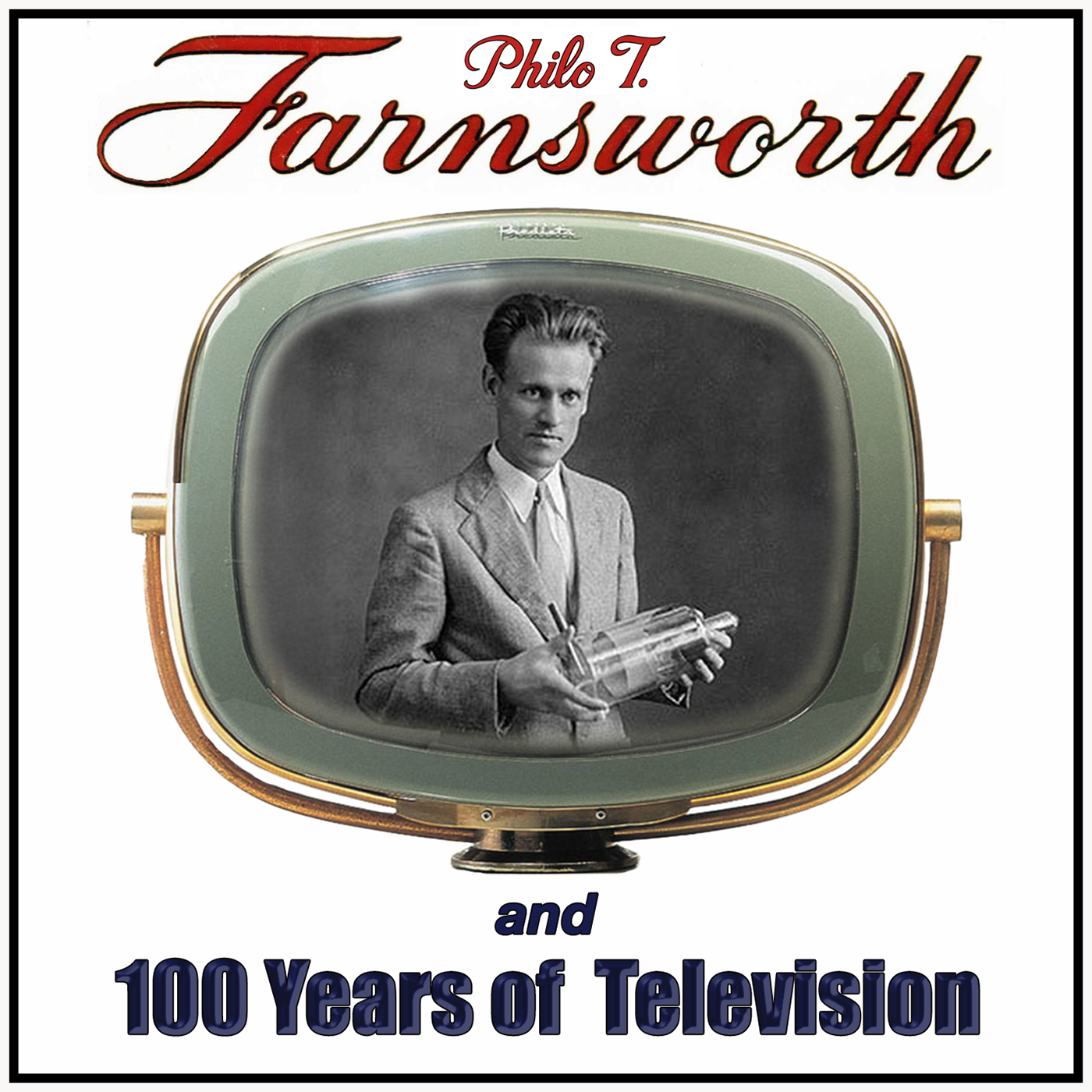
I'm Paul Schatzkin, author of the Boy who Invented Television, the definitive biography of Philo T. Farnsworth, who invented the world's first all electronic television system.
In the last episode, we witnessed the birth of America's annual televised bacchanal, the super bowl. Today is Countdown 47 all youl Need is Love.
Today's story begins in October 1945 when an article appeared in the British trade publication Wireless World with a title that sounded like something out of the future Extraterrestrial Relays Can Rocket Stations Give Worldwide Radio Coverage?
The article's author was Flight Lieutenant Arthur C. Clark, a 27 year old Royal Air Force radar instructor with no university degree whose only prior work had been published in small science fiction magazines.
In precise detail, Clark proposed that artificial moons satellites could be launched into something called a geostationary orbit.
By circling at an altitude of 36,000 kilometers, that's roughly 22,000 miles, the satellite's orbit could match the rotation of the Earth, thus appearing to be fixed in position above the Earth's surface.
That fixed location could then be used to relay radio and television signals to any point on Earth.
Clarke proposed that an orbiting relay station could serve a huge area of the Earth's surface, like a radio tower, thousands of miles high.
And while the actual cost of space travel had yet to be calculated, Clarke argued that an equally capable chain of terrestrial relay stations would cost millions and transoceanic services would still be impossible.
Arthur C. Clarke went on to considerable renown in the decades that followed, and to this day is regarded as the godfather of satellite communications.
But all these ideas remained in the realm of science fiction until the Soviet Union launched Sputnik, the first satellite of any kind, in October 1957.
The space race was on in earnest once that basketball sized orb started beeping down to Earth from the heavens above.
The era of satellite communications envisioned by Clarke and others took its first tentative steps toward realization in December, when the U.S. army launched Project SCORE, short for signal Communications by Orbiting Relay Equipment.
SCORE was not so much a free orbiting satellite as it was an Atlas rocket with a communications payload bolted on the whole thing. Rocket and payload was sent into orbit when SCORE broadcast a pre recorded Christmas message from President Eisenhower. That was the first human voice ever transmitted from space and a precursor of things to come after Score. Progress towards Clarke's vision was incremental over the decade that followed.
The first real communications satellite was Telstar, launched by the National Aeronautics and space Administration in July 1962.
Built and owned by the Bell Labs division of AT&T, Telstar was the first satellite capable of transmitting television sign the Atlantic.
Walter Cronkite, watching from the anchor desk in New York, noted that Telstar put the White House and the Kremlin no farther apart than the speed of light.
But Telstar had one critical its orbit was not geosynchronous and could only be used for about 20 minutes each time it orbited over the Atlantic.
Subsequent launches improved the signals.
Relay 1, built by RCA for NASA and launched in December 1962, provided a stronger signal than Telstar but was still short of a geosynchronous orbit.
Syncom 2, launched in July 1963, was the first to achieve geosynchronous orbit. And Syncom 3, in August 1964 was used to transmit coverage of the 1964 Summer Olympics in Tokyo, finally presenting direct proof of the concept Arthur C. Clarke had described almost 20 years prior.
Finally, on April 6, 1965, Intelsat 1, aka Earlybird, was launched into geosynchronous orbit as the first fully functional commercial satellite providing regular telecommunications and broadcasting services between North America and Europe.
Less than a month after its launch on May 2, 1965, Early Bird demonstrated its capabilities in a one hour TV spectacular that was broadcast to Europe from the U.S. canada and Mexico, the first time that a TV signal was sent between nine different countries on both sides of the Atlantic.
The broadcast featured three of the biggest names in broadcast journalism.
CBS's Walter Cronkite and NBC's Chet Huntley in New York and the BBC's Richard Dimbleby in Brussels, all marveling at simultaneous images from the New York World's Fair on one side of a split screen and scenes from Rome on the other.
Early Bird was just the first piece in a puzzle that would not come to full fruition until three more similar satellites were placed in other geosynchronous orbits. Over the next two years, Canary Bird joined Early Bird over the Atlantic.
Lanny Bird and ATS1 took positions over the Pacific.
Together, those four satellites stitched an electronic web between 14 countries across five continents. In real time, the pieces were at last in place to unite the global village. And both Marshall McLuhan and the Beatles were part of its inaugural festival in Britain. Aubrey Singer, the head of the BBC's features and science Division, had been pushing the idea of a global television broadcast since at least 1965.
As a senior executive, Singer had not only the vision but the clout to make such a thing happen.
Given the complicated logistics involved, Singer took the project to the European broadcasting union in 1966. Representatives from 18 countries met in Geneva and agreed to the project on two there could be no political content, and the whole thing had to be broadcast live.
The scale of the undertaking was staggering. Over a period of nearly a year, hundreds of producers, directors and technicians were lined up. A network of more than 40 control rooms was stitched together through nine satellite ground stations across North Americ, Europe, Africa, Japan and Australia.
All manner of technical and logistical issues kept the project in Limbo until Sunday, July 25, 1967, was settled on for the date when it would all come together.
All the elaborate planning for what was supposed to be a celebration of global unity nearly went off the rails on June 5, 1967, when Israel launched preemptive strikes against Egypt, Jordan and Syria.
What became known as the Six Days War in the Middle east triggered the Soviet bloc's withdrawal from the project, gutting one of its most ambitious to show east and west together in a McLuhanist global village without borders or divisive ideologies.
But the show went on, and the global broadcast of Our World kicked off in London at 7pm on Sunday, June 25, 1967, 3pm in New York, 12pm on the West Coast, 4am in Tokyo and 5am in Sydney, Australia.
And fittingly, the program began with a cameo by the guru himself.
From the Canadian Broadcasting Company's headquarters In Toronto, Marshall McLuhan conducted a brief interview, treating viewers to the classically McLuhanesque observation that most in the audience would experience the event by looking in the rearview mirror, seeing only what they already knew, while all around them the world was becoming something that it had never been before.
The two hour program was divided into six segments. The opening this moment's world, the crowded world, aspiration to physical excellence, Aspiration to artistic excellence, and the world beyond.
Over the next two hours, viewers witnessed live births in Japan, Denmark, Mexico and Canada.
Leonard Bernstein and Van Cliburn rehearsed Rachmaninoff at Lincoln Center, Franco Zeffirelli filmed a scene from Romeo and Juliet, Picasso painted in his studio. And at Cape Kennedy in Florida, preparations were underway for a rocket launch.
And ironically, Our World was broadcast on the final day of a weekend summit between US President Lyndon Johnson and the Soviet Union's Alexei Kosygin in Glassboro, New Jersey.
Even as segments from Eastern bloc countries like Czechoslovakia, East Germany, Hungary and Poland had been canceled, the leaders of the world's two superpowers were sitting across a table from each other in New Jersey.
Meanwhile, back in England, the world's most renowned rock stars were tuning up for the program's finale.
After the end of their tour in the United States in the summer of 1966, the Beatles had sworn off any further touring as a band.
They turned their attention instead to perfecting their techniques in the recording studio. A pivot that found them at the top of their game with the triumphant release of Sgt. Pepper's Lonely Hearts Club Band just three weeks before the Our World broadcast.
All the BBC wanted for the finale was a simple song with a unifying theme that could readily translate into any language or even better, require no translation at all.
Under considerable pressure, John Lennon composed an anthem of global unity. All you need is love.
For a few minutes prior to the actual performance, the band was shown rehearsing to pre recorded tracks while an audience gathered in their Abbey Road studio. When the rehearsals were finished, an ensemble of strings and horns was ushered into the studio.
The tension was palpable as all the technical elements came into alignment for what would be the Beatles first live performance before an audience in nearly a year.
Legend has it that producer George Martin and his engineer Jeff Emmerich was were so nervous as the moment approached that they each took a drag on a bottle of scotch, scrambling to hide the evidence when the transmission switched to Abbey Road nearly a minute before the scheduled time.
By the time the broadcast switched back, the studio was filled with luminaries including Eric Clapton and Keith Richards and Mick Jagger of the Rolling Stones.
Jagger was dressed for the occasion in a psychedelic silk coat that stood out among the assembly of friends and family that had gathered for the occasion.
At 8.54pm London time, the orchestra kicked in with the opening bars of Le Marseillaise, the French national anthem played by a British orchestra to open a song that would be seen and heard around the world.
As the cameras panned the room, Mick Jagger was caught puffing on a gigantic joint while some 400 million people tuned in all over the world with all you need is Love. The Beatles and their studio full of friends close the program. The world's first global satellite broadcast on the most unifying note possible.
This brings us to the end of number 47 in the countdown of the top 100 milestones in the first 100 years of television.
Stay tuned for the next episode when Walter Cronkite goes to Vietnam and returns with an outlook very different from the official story.
Thanks for listening to 100 Years of Television, a two year countdown to the centennial of television on September 7, 2027. For more, just aim the gizmo of Your Choice to 100yearstv.com this podcast was written, recorded, edited, engineered and uploaded by me, Paul Shatzkin, and is a production of farnovision. Com.
If television was invented by somebody named Farnsworth, why don't we call it Farnovision?
[00:14:35] Speaker A: They all said we never would be happy. They laughed at us and how but how food got the last lockdown.