Episode Transcript
[00:00:00] Speaker A: They all laughed at Christopher Columbus when he said the world was round.
They all laughed when Edison recorded sound.
They all laughed at Wilbur and his brother when they said that man could fly.
They told Marconi wireless was a phony.
[00:00:18] Speaker B: It's the same old welcome back to 100 Years of Television, where for 100 weeks that started in October 2025, we're recalling the top 100 milestones in the first 100 years of television and video.
The countdown will culminate on September 7, 2027. That's the 100th anniversary of the day television was invented.
I'm Paul Schatzkin, author of the Boy who Invented Television, the definitive biography of Philo T. Farnsworth, who invented the world's first all electronic television system.
In the last episode, the Beatles sang all you need is love by satellite to TV audiences around the world.
Today is countdown number 46. Walter Cronkite and the Living Room War When Lyndon Johnson assumed the presidency in 1963, few Americans had ever heard of Vietnam, an obscure former French colonial backwater in Southeast Asia that most people would have been hard pressed to find on a map.
The origins of the war in Vietnam are so complex as to seem almost diabolical, as if history itself had designed a trap and the United States backed right into it, eyes fixed on McCloughan's rearview mirror, still fighting the previous war against communism and certain that what had worked on the Korean peninsula in the 1950s would also work in the jungles of Southeast asia in the 1960s.
Before World War II, Vietnam had endured more than a half century of French colonial rule.
After World War II, Vietnam's interests were unified under the Viet Minh, a political movement spearheaded by Ho Chi Minh, a committed nationalist with both communist ties and American inspired anti colonial sympathies.
When Ho declared Vietnamese independence From France in 1945, he deliberately quoted the American Declaration of Independence, a direct appeal for the same right of self determination America had claimed for itself in 1776.
But America wasn't listening.
The French colonial project, already hollowed out by the war, finally collapsed in 1951 at Dien Bien Phu, a remote mountain garrison where Viet Minh forces surrounded and systematically wiped out an entire French expeditionary force after a 56 day siege.
The Geneva accords that followed France's withdrawal partitioned the country into north and south at the 17th parallel, an arrangement that was supposed to be temporary but pending elections in 1956 to reunify the country.
Those elections never happened, the United States, convinced that another domino was about to fall in the spread of international communism quietly backed the cancellation of those elections. For the next 20 years, there would be two Vietnams.
With the reunification forestalled, America's commitment to South Vietnam slipped in through the back door.
It began when the Eisenhower administration sent money and military advisors to prop up the government led by President Ngo Dinh Diem in Saigon.
At first there were fewer than a thousand technicians and military trainers.
There was nothing that could be construed as active military involvement.
John F. Kennedy inherited that arrangement after his inauguration in 1961 and expanded it, sending the advisor count past 16,000 by 1963.
There is credible evidence that Kennedy intended to withdraw if he was re elected in 1964, but was Leery of acting before the votes were counted. All that remains is speculation.
The actual calculus changed in Dallas on November 22, 1963.
Kennedy's successor, Lyndon Johnson, was hardly looking for an exit when North Vietnamese gunboats attacked American naval vessels. Allegedly In August of 1964, Johnson secured authorization from Congress the Gulf of Tonkin Resolution to retaliate however he saw fit.
The first American combat troops landed at da Nang in March 1965.
By the end of that year, there were more than 180,000American troops in country.
In 1966, the number reached nearly 400,000.
Each escalation was accompanied by assurances that the latest increment would turn the tide.
But by 1967, there were half a million American troops in Vietnam, and a hundred of them were coming home every week in boxes and on television, in living rooms from coast to coast. The casualty figures from a war that nobody had asked for became a nightly fixture of the evening news as regular as the weather.
Through most of the escalation, American media was largely compliant with the official story coming out of the Department of Defense.
Reporters covered the expanding war in Southeast Asia with both professional diligence and institutional deference, their coverage shaped by the Cold War sensibilities that first surfaced during Joseph McCarthy's rampage through the American psyche. In the early 1950s, the Pentagon held daily briefings in Saigon that correspondents started calling the five o' clock Follies for their cheerful tone and apparent disconnect from realities on the ground and back home. Vietnam was morphing into what Michael Arlin, the television critic for the New Yorker, called the Living room War.
That expression caught on because for the first time in the history of warfare, images of actual combat not sanitized newsreels, were flickering on nearly 60 million television sets, with roughly a quarter of them displaying the footage of the Death and destruction in living color.
Getting that footage on the air was a marvel of 1960s broadcast journalism in the field. Film crews, a reporter, a cameraman, a sound man, and often Vietnamese locals who knew the terrain followed the troops with an unprecedented degree of access to actual combat.
The crews operated with little military oversight, attaching themselves to infantry units, going on patrols and recording what they witnessed on 16 millimeter film.
The nightly news segment on Vietnam typically ran just two or three minutes, enough for a firefight, a correspondent reporting from a village, and a tally of the casualties.
But night after night, the war seeped into the living room.
For example, in August 1965, viewers of the CBS Evening News watched correspondent Morley Safer follow a company of Marines into the village of com nee and burn it to the ground with Zippo lighters.
Morley Safer reported that the operation burned down 150 homes, wounded three women, killed one baby, wounded one Marine, and netted all of four suspected enemy sympathizers, four old men who could not answer questions put to them in English and had no idea what an ID card was.
The military cooperated with the coverage in the mistaken belief that managed footage of American boys in action would rally morale at home.
Instead, the living room war planted the seeds of widespread discontent and ultimately an anti war movement like the nation had never seen before.
Unwittingly, television didn't just report the war, it recruited the domestic opposition.
As images glowed night after night on cathode ray tubes around the country, the footage produced a response the Johnson administration never anticipated, a defensible argument for just ending the war.
At the center of the resistance was the military draft, which was essentially a holdover from World War II and the early years of the Cold War.
The conscription of a generation raised on television to fight an undeclared and increasingly unpopular war produced a resistance staged for the medium.
In addition to the nightly war coverage, TV news began broadcasting footage of young men burning their draft cards on college campuses, while others fled to Canada as the moral justification for the war crumbled.
By the end of 1967, what had been simmering on college campuses coalesced into a national anti war movement.
On October 21, 1967, 100,000 protesters gathered at the Lincoln Memorial in Washington and marched across the Potomac to the steps of the Pentagon. The image that defined the day needed no caption. A young man sliding flowers into the barrel of a soldier's rifle.
The protesters understood instinctively what the Pentagon did not that the living room was the battlefield and the cameras were the weapon.
The resistance had become Theater staged specifically for the medium that had forged a generation's common experience.
The outlook for the war shifted even More dramatically on January 31, 1968, when North Vietnam launched simultaneous attacks on more than a hundred cities and towns across South Vietnam in what became known as the Tet Offensive.
In one audacious action, enemy forces briefly overran the American embassy in Saigon.
In the weeks just prior to the Tet Offensive, US General William Westmoreland had been assuring Congress that the enemy was degraded and exhausted and that the war had reached a point where, in his words, the end begins to come into view.
But the television cameras that were now permanently embedded in the streets and jungles told a very different story.
The images coming out of Saigon on the morning of February 1, including NBC footage of a South Vietnamese general executing a Vietnam prisoner on a Saigon street corner at point blank with a pistol, conveyed a determined adversary and a chaotic defense.
In the US the most devastating casualty was the last vestiges of official credibility.
In New York, CBS News anchor Walter Cronkite watched the footage as it spooled out in the newsroom.
Then he booked a flight to Saigon.
Walter Cronkite, generally regarded as the most trusted man in America, arrived in Saigon on February 11, 1968, to the sound of bombs and artillery in the near distance.
He rode into the city, past the scared faces of children lining the road. The same hollow look he noted, that he had seen in the eyes of refugees during World War II.
Over the next two weeks, Cronkite interviewed American and South Vietnamese officials and reported from the battlefields at Hue and Khe Sanh.
He spoke directly with General Westmoreland, who insisted to Cronkite's face that America was on the verge of victory. At the same time, he was telling Congress that all it would take was another 200,000 troops.
Cronkite returned after three weeks, haunted by the same conclusion that had been forming in the gut of the country for months, but had yet to be spoken aloud by anyone with the authority to make it matter.
At the close of a special report on the war at the end of the CBS Evening news on February 27, 1968, Walter Cronkite stepped outside of every professional boundary he had spent his career observing, looked directly into the camera and shared his speculative, personal and subjective conclusions with the American public.
[00:13:56] Speaker C: For it seems now more certain than ever that the bloody experience of Vietnam is to end in a stalemate.
To say that we are closer to victory today is to believe in the face of the evidence. The Optimists who have been wrong in the past.
But it is increasingly clear to this reporter that the only rational way out will be to negotiate, not as victors, but as an honorable people who lived up to their pledge to defend democracy and did the best they could.
[00:14:29] Speaker B: This was, by the standards of American journalism, a nearly unprecedented breach of journalistic programs protocol.
News anchors were moderators. They did not render verdicts. They surveyed their domain. While entrenched in the long standing tradition of separation between facts and opinions that assured that men like Walter Cronkite could be trusted in the first place, he willingly crossed that barrier with full knowledge of his reach and the potential consequences.
As surprised as much of the audience surely was to hear Cronkite's pronouncement, there was one American citizen who must have been genuinely shocked.
That night, Lyndon Johnson was in Austin, Texas, attending a birthday party for Texas governor John Connally.
When he got wind of what Cronkite had said, he got hold of a recording.
After viewing the broadcast, Johnson flipped off the set and said, if I've lost Cronkite, I've lost America.
A month later, in an even more shocking turn, Johnson announced during a televised address to the nation that I do
[00:15:43] Speaker C: not believe that I should devote an hour or a day of my time to any personal partisan causes or to any duties other than the awesome duties this office.
Accordingly, I shall not seek and I will not accept the nomination of my party for another term as your president
[00:16:12] Speaker B: so that he could devote himself entirely to ending the quagmire in Vietnam.
And with that, the most powerful man in the world had been brought to his knees, not by his constituents, not by Congress, not by his generals, and not by the enemy, but by a man on a screen in a box in America's living rooms.
The anti war movement went on and support for the war fell further. But America's entanglement in Vietnam dragged on for another seven years.
While negotiations continued in Paris to end the war, Lyndon Johnson's successor, Richard Nixon, implemented a program of Vietnamization, slowly putting the war back into South Vietnamese hands while US Troops quietly withdrew.
The Paris accords to end the war were signed on January 27, 1973, and the last American troops withdrew two months later, on March 29. But the war didn't end until April 30, 1975, when North Vietnamese tanks rolled into Saigon. Saigon.
On July 2, 1976, the two Vietnams were finally reunited as the Socialist Republic of Vietnam, and Saigon was renamed to Ho Chi Minh City for the leader of the movement who had died in 1969.
And on November 13, 1982, seven years after the fall of Saigon, the Vietnam Veterans Memorial was dedicated in Washington D.C.
a granite wall carved with the names of more than 58,000 dead Americans nationwide. Protests had divided the nation over an unjustified and unwinnable war. But two minutes of commentary on TV from the most trusted man in America was the first breath of a mighty wind that eventually turned the tide.
This brings us to the end of number 46 in the countdown of the top 100 milestones in the first 100 years of television.
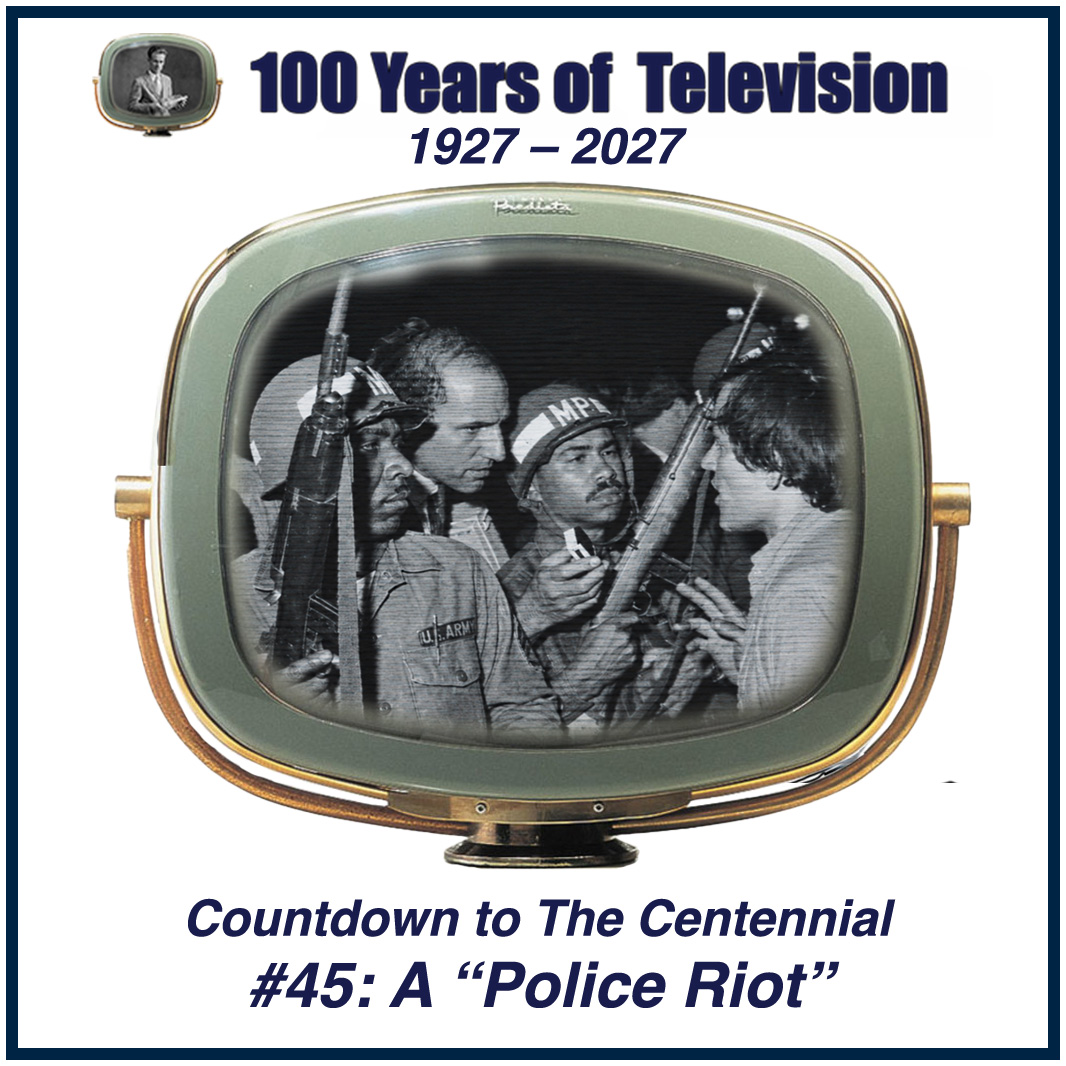
Stay tuned for the next episode when the anti war movement erupts on the streets of Chicago in the summer of 1968.
Thanks for listening to 100 Years of Television, a two year countdown to the centennial of television on September 7, 2027.
For more, aim your gizmo to 100yearstv.com this podcast was written, recorded, edited, engineered and uploaded by me, Paul Schatzkin and is a production of Farnovision.com if television was invented by somebody named Farnsworth, then why don't we call it Farnovision?
[00:19:12] Speaker A: They all said we never would be happy. They laughed at us and how but how we got their lives right now.