Episode Transcript
[00:00:00] Speaker A: They all laughed at Christopher Columbus when he said the world was round they all laughed when Edison recorded sound they all laughed at Wilbur and his brother when they said that man could fly they told Marconi wireless was a phony it's the same old cry.
[00:00:21] Speaker B: Welcome back to 100 Years of Television.
This is episode number 47, countdown number 60.
This changes everything.
For 100 weeks that started in October of 2025, this podcast is going to recall the top 100 milestones in the first 100 years of television and video.
The countdown is pegged to culminate on September 7, 2027, the 100th anniversary of the day television was invented. Paul I'm Paul Schatzkin, author of the Boy who Invented Television, the definitive biography of Philo T. Farnsworth, who invented the world's first all electronic television system.
In the last episode, we witnessed the dawn of the TV remote and the rise of the couch potatoes. Today, video meets the the videotape recorder at least two Russian names figure prominently in the early history of television.
Boris Rosing, who proposed an all electronic approach to television and experimented with cathode ray tube receivers in 1907, and Vladimir Zworikin, a protege of Rosings who brought those ideas to the United States in 1921.
But there is one other, far less heralded Russian immigrant who had an equally undeniable impact on television in the 1950s who, not coincidentally, shares his lineage with Rosing and Zwarykin.
Alexander M. Poniatov was born on March 25, 1892 in Kazan, on the Volga river in what was then the Russian Empire.
He studied at the Imperial Institute of Technology in St. Petersburg, the same institution where Boris Rosing was a professor and Vladimir Zorkin was Rosing's protege, where Poniatov earned his certifications in electrical and mechanical engineering.
Poniatov fled Russia after the Bolshevik Revolution, finding his way to the United States in 1927.
In San Francisco, he worked for a while for General Electric before founding the Ampex Corporation in 1944, naming it from his initials, a.m.P.
and adding the X for excellence.
If you have ever seen footage of live television shows from the 1940s or early 1950s, that's as opposed to programs originally produced on film like I Love Lucy and the Honeymooners.
Then what you are seeing is known as a kinescope footage filmed with a 16 millimeter camera aimed at a cathode ray tube studio monitor.
There was no direct way to record video until Alexander Pontioff's company attacked the problem.
What the television industry needed was a video version of the kind of recording devices that were readily available for audio by the 1950s.
Recording sound began in 1877 when Thomas Edison read the poem Mary Had a Little Lamb while turning a crank on a new invention he called the phonograph.
As Edison spoke into the microphone, a needle etched fluctuations into a cylinder coated with tinfoil that rotated as the crank handle was turned.
When he replaced the microphone with a speaker cone, the poem was heard back from the cylinder.
Ten years later, in 1887, the German born American inventor Emil Berliner took the Edison concept a step further with a flat disc rather than a cylinder in a device he called the gramophone.
And in 1898, the Danish engineer Valdemar Poulsen introduced the Telegraphone, which recorded sound magnetically on steel wire.
The next big breakthrough in audio recording appeared in the 1930s when the German Austrian engineer Fritz Pfleumer developed the Magnetophone, which recorded sound on plastic tape coated with an iron oxide powder instead of wire.
The German army used the magnetophone extensively during World War II.
After the war, U.S. army Signal Corps engineer Jack Mullen returned from Germany with two captured Magnetophone recorders and 50 reels of tape.
He rebuilt and started to demonstrate the units in 1946.
One broadcaster who was impressed by Mullins demos was Bing Crosby, who disliked performing live radio broadcasts.
Crosby had a running feud going with NBC over his insistence on using transcription discs for his broadcasts, which the network insisted delivered poor sound quality.
When Crosby heard that the audio quality from Mullin's magnetophone was indistinguishable from live over the air audio, he figured his problem was solved.
At first, Crosby hired Mullen to record his radio show with the captured German machines.
Then he joined forces with a still tiny company in California called Ampex.
Crosby's investment and endorsement was enough for Alexander Pontiatov's engineers to develop the Model 200, the first professional quality audio tape recorder, and deliver the first production units to bing Crosby in 1948.
Subsequent success provided the expertise and capital for Ampex to make a run at video recording, which represents monumental challenges of bandwidth and storage.
A high fidelity audio recording can be easily stored on just a quarter inch of magnetic tape running at as little as 7 or 15 inches per second.
But at 525 lines per frame and 30 frames per second, a video signal requires orders of magnitude more capacity than any audio tape could handle.
All of the engineering challenges boil down to one governing speed.
Audio tape recorders rely on a single fixed magnetic head to encode sound by magnetically rearranging the iron oxide particles adhered to the plastic tape.
But in order for a single fixed head to work with a video recorder, the tape would have to fly by the head at something approaching a measurable fraction of the speed of light.
A team of engineers at Ampex came up with a solution.
First, project leader Charles ginsberg calculated in 1952 that with a single fixed head, the tape would need to move at more than 1,000 inches per second.
Then two other engineers, Shelby Henderson and Charles Anderson, proposed a novel Keep the tape running at a conventional 15 inches per second, but spin multiple heads across it with a rotating drum.
Another young engineer fresh out of Stanford, Ray Dolby, helped design the electronics and servo systems that made the spinning head system workable. And the Ampex team developed a system called quadruple.
The ingenious approach started with a drum that spun at 14,400 rpm or 2,400 rpm to spin four heads perpendicular to a two inch wide tape that could turn past the spinning drum at a manageable 15 inches per second.
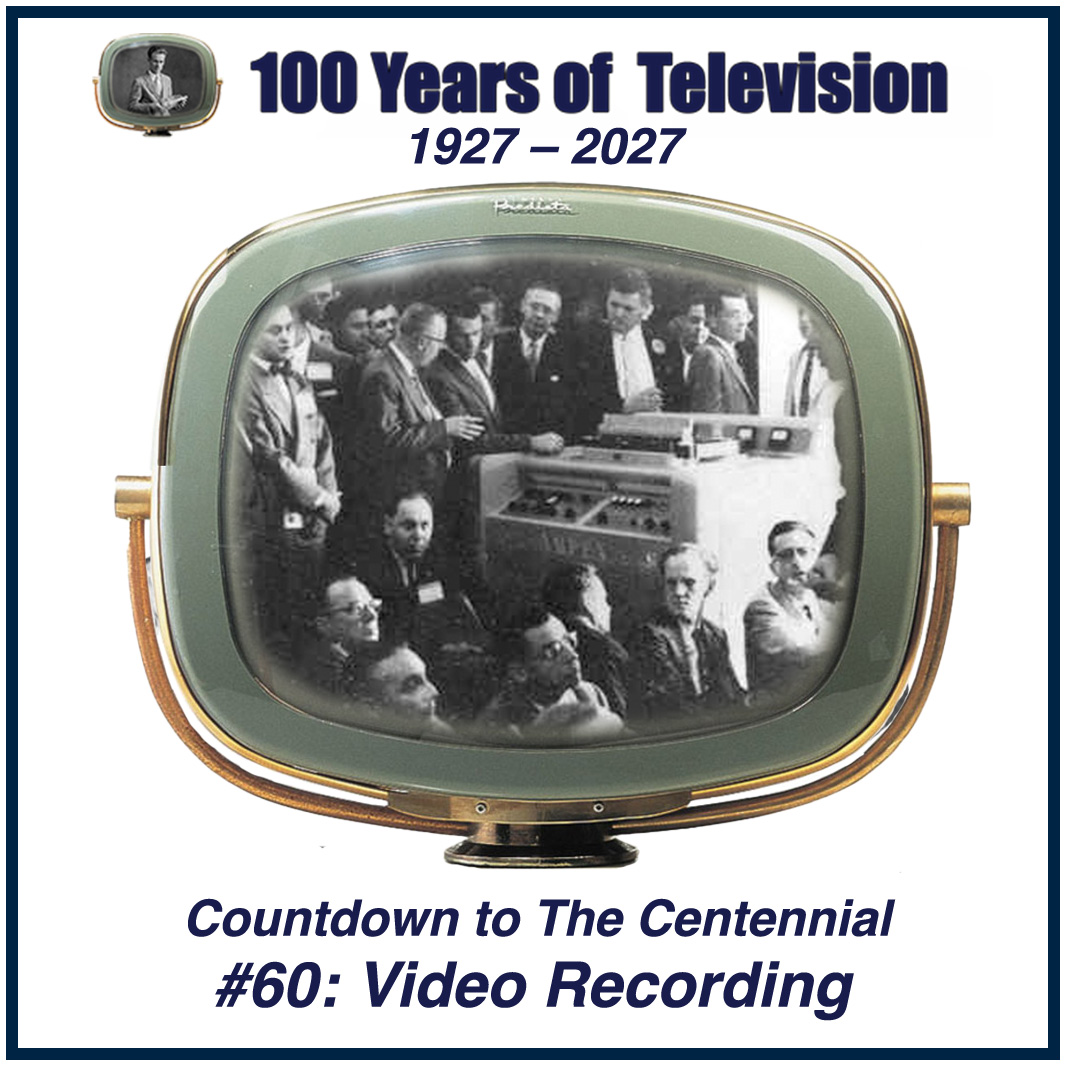
The world's first videotape recorder, the Ampex VRX1000, was unveiled on April 14, 1956, at the Chicago convention of the national association of Radio and Television Broadcasters.
Rumors had been circulating through the industry that Ampex was working on something magnetic, but almost no one outside the company knew that Ampex had cracked the code.
The VRX1000 was a behemoth the size of a large refrigerator laid on its side and weighed more than half a ton.
It used 2 inch wide magnetic tape on a 14 inch reel capable of recording an hour of both video and audio.
To demonstrate the new machine, Ampex engineers played back a pre recording of the previous day's session.
The picture quality was astonishing. Clear, steady and indistinguishable from a live video camera feed.
When the playback demonstration ended, hundreds of broadcasters, including executives and engineers from rca, NBC, CBS and abc, all rose to their feet in an ovation that lasted for nearly a minute. Ampex founder and CEO Alexander Poniatov, stood by beaming proudly with the team led by Charles Ginsberg, along with Alex Maxey, Fred Foost, Shelby Henderson and Charles Anderson, the core engineers who had perfected the machine just weeks earlier.
Fred Foast, who actually pressed the play button, said, it was the greatest day of my life.
[00:10:28] Speaker A: Life.
[00:10:30] Speaker B: Later that day, CBS vice president Bill Lodge told reporters and colleagues, gentlemen, this changes everything.
As soon as they went on sale later that year, NBC, CBS and ABC purchased the first production units for $45,000, the equivalent of roughly half a million dollars in 2026.
Just a few months after the unveiling, CBS and NBC were using the Ampex machines to timeshift Douglas Edwards and the news and Arthur Godfrey's talent scouts to the West Coast.
The next year, NBC's Truth or Consequences was the first show aired in all time zones from pre recorded videotape. Within a year, quad was the de facto standard for time zone delay, and over the ensuing decade recorded live became as common as programs produced on film.
The VRX1000 was an unquestionable breakthrough in television technology.
It was also a bit of a bear to operate.
Before recording or playback, operators took several minutes to calibrate azimuth guide positions, head currents, servos, and other circuits.
And the guts of the VRX1000 relied on nearly 200 hot vacuum tubes, which prompted one early operator to joke that the machine was half recorder, half space heater.
Over time, video recording became standard operating procedure.
When Jack Par took over from Steve Allen in 1957, NBC's the Tonight show began recording for rebroadcast to the West Coast.
CBS began videotaping selected episodes of its prestigious Playhouse 90, starting with the Miracle Worker in 1957.
Soap operas, game shows, and variety shows all shifted from live to pre recorded by the mid-1960s.
That 2 inch quadruplex format dominated video recording for almost 20 years.
Starting in the mid-1970s, the industry turned toward helical scan recorders, which used just two recording heads situated 180 degrees apart that spun across the tape horizontally instead of vertically.
By then, solid state circuits like transistors and integrated circuits had mostly replaced vacuum tubes, and machines like videotape. Recorders became much more compact and reliable.
By the mid-1970s, videotape had become a medium in its own right, and producers began to explore its unique abilities ability to emulate the immediacy of live television for narrative drama.
Over two nights in October 1974, ABC broadcast what is widely considered the first motion picture for television produced on videotape.
The Missiles of October was a dramatization of the Cuban missile crisis in 1962, starring William Devane as John F. Kennedy and Martin Sheen as Robert Kennedy.
Two years later, PBS aired the Addams Chronicles for the United states bicentennial in 1976.
The Addams Chronicles borrowed many set design, lighting, and editing techniques from film, but producing station WGBH Boston heralded the program explicitly as a motion picture for television recorded on videotape.
Alexander Pontiatov was not directly involved in the day to day engineering of Ampex's pioneering video recorders, but he was the company's president and guiding light.
He fostered the creative environment in which skilled engineers like Ginsberg, Henderson and Dolby could take on the sort of ambitious, costly risks it took to produce the first videotape recorder.
Not even the mighty RCA could get into manufacturing video recorders until it reluctantly licensed the quadruplex patents from Ampex in 1957.
Video recording has now become one of the staples of the modern world, as ubiquitous as the screens themselves.
The first machines were huge and complex, but now it's all digital and everybody with a smartphone has the equivalent of an Ampex VRX1000 in their pocket.
One quick footnote before we go if the name Ray Dolby sounds familiar, that's because after earning a PhD in physics from the University of Cambridge, he founded a company called Dolby Laboratories in London in 1965.
His company introduced Dolby noise reduction in 1966, which revolutionized magnetic tape recording, followed by innovations such as Dolby Stereo for film soundtracks and Dolby Surround and Dolby Digital Technologies that redefined high fidelity audio in cinema, music and home entertainment for decades.
Now you can tie his name into the early days of television too.
This brings us to the end of number 60 in the countdown of the top 100 milestones in the first 100 years of television.
Stay tuned for the next episode when TV goes off to see the wizard.
Thanks for listening to 100 Years of Television, a two year retrospective countdown to the centennial of television on September 7, 2027.
For more, just aim your gizmo to 100yearstv.com this podcast was written, recorded, edited, engineered and uploaded by me, Paul Shatzkin, and is a production of Farn Farnovision.com. if television was invented by somebody named Farnsworth, then why don't we call it Farnovision?
[00:16:50] Speaker A: They all said we never would be happy they laughed at us and how but how we got the last night down.